June 1, 2010 by Anastasia Ashman

This blog **HAS MOVED** to expat+HAREM, the global niche, where my cultural producer posts now appear in a new series called Founder’s Desk.
LET’S STAY CONNECTED
- You can continue to receive my posts (and those of expat+HAREM’s fab guest bloggers from around the world, which I editorially direct) at Facebook via Networked Blogs by joining here.
- Or, get all of expat+HAREM’s posts by email here.
- Or, if you’re the RSS type, subscribe to the expat+HAREM syndicated feed to read it in Google Reader, Yahoo, Netvibes, etc.
Thanks for spending time at Furthering the Worldwide Cultural Conversation this past year — it’s been a year this month! — I appreciate it.
See you on the other side…
Posted in American culture, culture, friendship, harem, history, identity, memoir, society, taboo, women | Tagged blog migration, expat+HAREM, Founder's Desk |
May 27, 2010 by Anastasia Ashman
According to the Tibetans, today is Buddha’s birthday. A prince with everything in the world, he set off on a quest to discover the truth of life. I’m remembering a mindfulness adventure I had this week, fifteen years ago:

Bornean Buddha by A.Ashman
In Borneo, I felt bored and restless at a luxe, manicured Shangri-La resort favored by fugitive rogue traders. Wandering past the watersports shack I asked to go to an outlying island in the South China Sea. No notice to the people I was traveling with, no drinking water, food or cellphone.
The white-uniformed sailor dropped me at the random spot I’d picked from his laminated map. A decrepit picnic bench sagged in the shade of a steep cliff carpeted in greenery, where faceless monkeys screeched. No facilities, no stand selling lunch, no people. Just plastic flotsam and slithery tracks lacing the sand. The hotel boat fishtailed away.
Did they write down where they left me? Lawsuit waiting to happen. Already thirsty. Wait, six-inch wide tracks. From what scaly beasts?
No way I’d approach the trees where those squiggly trails led. I was frying in the tropical sun. Unnerved to cool off in the translucent green water. What if I suddenly ‘had trouble’ swimming, or a shark came? Maybe I could flag down a passing boat to take me back. But these were pirate-infested waters.
Silly overreaching hotel guest, I was going to die on this wild island.
I picked up a 5-liter water jug and started filling it with cones and olive shells glinting among seaweed and garbage. Good stuff. My best vacations were spent shell-collecting in the Gulf of Mexico…Sanibel Island in Florida.
Heavenly new finds here. A true Shangri-La paradise. Zebra-striped scallops. Glossy limpets. Spiky orange coral.
That day as I ringed the tiny island — is that a chickpea cowrie? – I turned the corner on my own nature’s bitter edge.
On this birthday week of Buddha can you name a mindfulness experience you’ve had?
This blog has moved. Comment here.
Posted in culture, history, identity, society | Tagged anger, appreciation, beachcomber, beachcombing, boredom, Bornean, Borneo, Buddha, Buddhism, caprice, civilization, cone shell, coral, cowrie, dependence, desert island, East-West, Florida, Gulf of Mexico, hotel, human nature, Kota Kinabalu, limpet, litigation, Malaysia, mindfulness, monkey, nature, Nick Leeson, olive shell, paradise, pirate, presumption, reptile, resort, Sabah, Sanibel, seashell, self loathing, self sufficiency, Shangri-La, shell collecting, snake infested, snakes, South China Sea, Southeast Asia, suffering, Tanjung Arung, Tibet, Tibetan, travel, tropical island, tropics, wild, wilderness, zen | 5 Comments »
May 17, 2010 by Anastasia Ashman
I’ve always admired the rugged ability of certain adventurer-writers to appear masterful in the wider world.
 True or not, it’s easy to envision legendary expatriate authors like Karen Blixen and Ernest Hemingway crushing it in their overseas exploits. Satisfying wanderlust. Surviving exotic illness. Operating transnational businesses. Donning local garb or exploration gear. Pictured alone on the landscape, or comfortably surrounded by teeming locals. Iconic.
Then they write personally relevant opuses Out of Africa and The Old Man and the Sea.
Larger-than-life expat writer personalities seem in tune with far-flung surroundings, able to produce their best work from foreign atmospheres.
These two predecessors were clearly troubled. Alcoholism. Venereal disease. Financial ruin. Divorce. Suicide. However, aspiring to their ultimate of travel feats — achieving a personal and professional high point — remains an urge for writers abroad like me.
I explore my own brush with the weight of expat image expectation at a colleague’s blog this week by delving into the photos that correspond with a highlight and a lowlight of my expat experience. Despite previous and future international depths, it only takes one flashbulb moment to remind us we too can outdo ourselves abroad. And that memory can empower us and our expat life for a long time. Take a peek at Unrecognizable vs. Iconic.
Which expat icons do you admire — and when have you found authority overseas?
This blog has moved. Comment here.
Posted in culture, history, identity, society | Tagged deep sea fishing, Ernest Hemingway, expat celebrity, expat life, expat lit, expat personalities, expat writer, expatriate, expatriate literature, expatriate writer, icon, Isak Dinesen, Karen Blixen, Old Man and the Sea, Out of Africa, productivity, unrecognizable, wanderlust, writer, writing |
Recently LocationIndependentProfessionals.com asked why we want to be location independent. “Whatever you’re looking for you can find where you are.” It’s simply not true.
We can get what we want and need where we are — but not with a local solution. Try a psychic one.
 Take this week’s short and balmy trip to Manhattan. I acted as a technology mule, bringing iPads to poor, under-served early adopters here in Istanbul, and reconnected with friends doing work I admire on scales and with methods I aspire to. My peers.
Right up my alley. But I may never live there again. Most of us cannot (always) go somewhere on the ground where all our people and our perfect lifestyle exist. We must find that psychically — our “global niche“.
The meaning and purpose of location independence and digital nomadism is to live and work autonomously. Although it evokes mobility, it’s especially crucial for long term living situations: to find a way to get what you want and need despite the limitations of your location. Much like the cross-national quandary posed at expat+HAREM — “are you a global citizen by choice, or necessity?” — out of necessity to live and work to my abilities I aim to be independent of my specific location.
Are you location independent by choice, or necessity? Where and why?
This blog has moved. Comment here.
Posted in American culture, culture, friendship, identity, society, women | Tagged activism, Angelique Kidjo, author, Babbo, Beat Generation, Beatnik, Benin, Beninese, Berkeley, Berkeleyan, Brooklyn, Colum Sheehan, designer, digital citizen, digital nomad, digital nomadism, early adopter, East-West, East-West medicine, French, global citizen, global niche, Guido Cruz, hipster, human rights, interactive media, iPad, iPad app, iPhone, iPhone app, Leslie Dann, lifestyle design, LIP, Lisa Oz, location independent, Location Independent Professionals, location-independence, Lorna Graham, Manhattan, Mario Batali, Mehmet Oz, multimedia, multimedia producer, New York, New York Times bestseller, novelist, professional, psychic, radio producer, The Ghost of Greenwich Village, Thrilling Heroics, United Nations, United Nations Radio, war crime, writer | 4 Comments »
April 24, 2010 by Anastasia Ashman
Matador network recently published “what not to do in Istanbul.” Suggestions to avoid crowds, tourist traps, deal with time constraints and low budgets, partake in local customs. It can be an overwhelming city and a list of what not to do is very helpful.
After seven years in this surprising megalopolis I agreed with very few of the suggestions.
I rarely contribute travel pieces anymore — focusing more on cultural identity work and pursuing hybrid entertainment — but since the tourism season approaches here are the points I see differently:
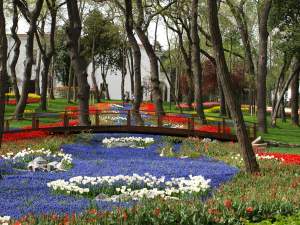
Emirgan Grove by A.Ashman
Ø *Skip Dolmabahçe*. (It’s a 19th century European-style palace and if you’ve ever seen one of those, this won’t be news). No exhibits and you can’t wander by yourself.
√ *Don’t skip Topkapı Palace* and don’t skip the separately ticketed harem tour. (Just go early after a big breakfast like I suggest here). It’s worth seeing the treasury, and the tiled kiosks at the far end of the compound, as well as the kitchens. Also you can pop into the stupendous archaeology museum on the grounds.
√ *Do stay in Taksim* if you want to experience a more authentic Turkish scene. Istiklal is perfect for dining, bar-hopping, strolling, people-watching, cafe-sitting. Some hotels are on raucous streets (travel with earplugs), but not all of them. (Sultanahmet may be close to the historic sites but it’s shark-bait touristy, and lifeless at night.) Taksim is on the Metro line, with a funicular that puts you on the tram to Sultanahmet. The most painless commute in town. Plus, the trek back and forth between old town and Beyoğlu, across Galata bridge, is one you’ll enjoy having to make as my walking tour for National Geographic shows.
√ *Do take a Bosphorus cruise*, just not the overpriced tourist traps from the Eminönü dock. Catch a lovely one hour $5 ferry from the landing behind the Ortaköy mosque like I describe here.
Ø *Skip the Princes Islands* if the reason you’re getting on a boat is for the views and breezes. The high speed boats that carry you to the Sea of Marmara have scratched plastic windows you can’t see out of, and you’re not allowed on deck.
Ø *Don’t accept tea* if you don’t want to spend your time with a particular person, or in a particular place. Don’t confuse a tourism sales tactic with the fabled Turkish hospitality. As a traveler in a big city, it’s still your time, and your choice who you drink tea with. If you’re interested in chatting or shopping, fine. If not, politely decline and keep moving. When hawkers in the bazaar and tourism district are unrelenting a clucking of the tongue and upward roll of the eyes is Turkish for “no, and don’t ask me again”. Plus, apple tea is only for tourists. If you aim to drink tea in a traditional manner, ask for normal black tea.
What would you suggest we *not* do in Istanbul, and why?
This blog has moved. Comment here.
Posted in culture, harem, history, society | Tagged apple tea, archaeology museum, bar-hopping, bazaar, Beyoğlu, body language, Bosphorus, Dolmabahçe, Eminönü, Galata, Galata bridge, Istanbul, Istanbul travel advice, Istiklal, Matador, Matador network, people-watching, Princes Islands, Sea of Marmara, shark bait, Sultanahmet, Taksim, Topkapı Palace, tourism, tourism district, tourism tactics, tourist trap, travel, travel advice, travel service, travel writing, traveler, Turkey, Turkish, Turkish hospitality | 14 Comments »
April 12, 2010 by Anastasia Ashman
This week I’m thrilled to be featured in Chantal Panozzo’s WriterAbroad Interview series.

I join fellow expat and global nomad authors like the Petite Anglaise blogger-turned-novelist Catherine Sanderson in France, veteran Expat Expert publisher Robin Pascoe, Maya “The New Global Student” Frost in Argentina, and Alan Paul, the Wall Street Journal’s “The Expat Life” columnist based in China.
Chantal — an American in Switzerland whose work appears in the dysfunctional family Chicken Soup anthology with mine, and guest posted last week at expat+HAREM — asks how to connect with a reading audience back home.
People abroad have often turned to writing when other options for work and expression were limited. It tends to be a location-independent profession and pasttime.
Technology and the times now challenge writers abroad to do even more. Because we can — and must.
We can make a bigger impact with less resources. Plus, even if we wanted to, we can no longer depend solely on high-barrier traditional routes. We writers are now producers, and directors, and engineers of content.
Revisiting all my entertainment projects in development in this new light: how to tell the story of my ‘forensic memoir of friendship’ using 25-years worth of multimedia? Can two screenplays be converted to enhanced ebooks for iPhone or iPad — incorporating images, sound, text — or even made into a graphic novel?
What recent technology or industry shift both lowers a traditional barrier for you and raises your game?
This blog has moved. Comment here.
Posted in American culture, culture, friendship, history, identity, memoir, society | Tagged Alan Paul, All in the Family, Argentina, author, career, Catherine Sanderson, Chantal Panozzo, Chicken Soup for the Soul, China, citizen of the world, content engineer, creative, creativity, digital citizen, digital nomad, director, e-book, ebook, enhanced e-book, enhanced ebook, entertainment, Expat Expert, expat+HAREM, global nomad, graphic novel, interactive media, iPad, iPhone, location independent, location-independence, Maya Frost, multimedia, novelist, Petite Anglaise, producer, producing, publishing, Robin Pascoe, screenplay, script, social media, success strategy, Switzerland, The Expat Life, The New Global Student, traditional barrier, Wall Street Journal, writer, Writer Abroad, writing | 8 Comments »
March 30, 2010 by Anastasia Ashman
All this talk about finding your tribe. It’s so rewarding to connect to people with similar world views. True peers.
As we seek our global niche, we’re integrating across all sorts of out-moded boundaries. You could also say we’re segregating along the lines of our true selves.
Perusing a Berkeley Grade School Photos group at Facebook, I marvel at the sea of white faces in the hill school districts in the ’40s to early ’60s — all those boys in their khaki Cub Scout regalia, an aggressive club requirement on picture day. Although the town’s schools were segregated simply by neighborhood, socioeconomic class lines also cut along race so Berkeley voluntarily desegregated itself, one of the first mid-sized American cities to do so. The integration program is reflected in a sudden appearance of multiracial group portraits.
Around the same time, the local government voted to rename its schools, exchanging African American civil rights leaders for the nation’s founding fathers. In a major gilding of the lily, Lincoln became Malcolm X.
At 9, I was bussed to the flatlands to an institution still bearing the name of a gentle Yankee poet. Its yard littered in glass, a burned out car lodged in a stairwell on a Monday morning. A hardcore new learning environment, and new peers!
Perhaps my parents skewed the fuller lesson in ethnic and socioeconomic diversity by signing me up for the academically competitive Asian Cluster classes, which confined me to rooms where Japanese, Filipino and Chinese students gathered. Integration has its casualties too.
What casualties of integration — or segregation — litter the path to finding your tribe?
This blog has moved. Comment here.
Posted in American culture, culture, history, identity, society, taboo | Tagged Abraham Lincoln, African American, Asian Cluster classes, authenticity, Berkeley, Berkeley Unified School District, bussing, Caucasian, Chinese, civil rights, Cub Scouts, Daily Om, desegration, ethnic diversity, Facebook, Filipino, finding your tribe, founding fathers, fourth grade, global niche, grade school class photo, integration, Japanese, Longfellow, Malcolm X, multiracial, peer group, race, school district, seeking our global niche, segregation, socio-economic class, socioeconomic class, tribe, true self, voluntary desegregation, voluntary integration, world view | 5 Comments »
March 22, 2010 by Anastasia Ashman
Passion fuels the lives we envision for ourselves better than discipline or elbow grease alone.
However, a little bit of passion’s dark side — anger — may be the best defense of our identity, and a future that looks like us.
 This week Dialogue2010 participant Elmira Bayraslı shared the anger that keeps her hybrid. Rather than assimilate or choose one social group to belong to, the daughter of Turkish immigrants in New York ferociously defends her hard-won ability to switch to independent American woman — and back again.
As an expat I know this righteousness-to-be-hybrid. A defense mechanism not only kicks in but is kept in place by a low level anger about external pressures to live and be a certain way. It’s been a cornerstone of my survival, and for many people living between worlds.
Today I was reminded exactly how homegrown this righteousness is by a Facebook group of one-line jokes about Berkeley upbringings. How counterculture taboos affected childhood is dizzying:
- boycotts of table grapes and iceberg lettuce make kids anxious when visiting un-PC families,
- a sneaked McDonald’s meal draws punishment while smoking weed does not,
- the Girl Scouts and Boy Scouts are off-limits (pseudo-military!),
- while the whitebread Brady Bunch and misogynistic Barbie are what’s wrong with the world.
Free Speech protests witnessed from baby strollers make this group a veritable Red Diaper Baby playdate.
Also glimpsed: the realization that much of what characterized a Berkeley childhood thirty or forty years ago — that is, the lifestyle and belief system of an alternative community, the anger that separated it from the rest of the nation — has now become mainstream in America.
So, my righteous sisters and brothers, what are you going to keep being angry about when it comes to who you are?
This blog has moved. Comment here.
Posted in American culture, culture, history, identity, society, taboo, women | Tagged activism, alternative, anger, angry, assimilation, Barbie, belief, belief system, Berkeley, Boy Scouts, boycotts, Brady Bunch, childhood, children, countercultural, counterculture, Dialogue2010, Elmira Bayrasli, Facebook, Free Speech Movement, Girl Scouts, immigrant, integrity, lifestyle, marijuana, McDonald's, military, mindset, nostalgia, nuclear proliferation, passion, PC, politically-correct, righteous, righteousness, self actualization, status quo, Turkish, un-PC, United Farm Workers, upbringing, weed, whitebread | 7 Comments »
March 11, 2010 by Anastasia Ashman
Numerous primitive and tribal cultures believe a person’s soul is stolen when they’re photographed. I wonder if a photograph shows a soul being drained.
I’m delving into mental and photographic snapshots of my 12 year expat experience for a colleague’s blog: one highlight, one lowlight. The lowlight will be hard to choose.
My five years in Asia in the ’90s would amount to great adventure for most people, yet the evidence clumps together in my least favorite albums.
Off-camera life losses — separation from family, friends, language, community, the death of my best friend, the theft of my puppy, you name I lost it during my first longterm stint abroad — are reflected on-camera. Stripped of my cosmopolitan composure. Confident clothing. Gleaming skin. Chocolate curls. Toothy smile. Layer by layer, country by country, year by year I deplete and erode.
There are some monstrous stunners here.
 Sweaty and sun-damaged with unschooled fluffball haircut, captured in the gracious gardens of Raffles Hotel. I’d given up sunscreen, as well as hair products and all hope of finding a stylist who understood fine and curly.
On the Great Wall of China, scowling Westerner in unladylike Doc Martens and baggy seersucker shorts (the only ones in the shops, I swear!), surrounded by svelte Chinese girls in platform shoes cheerfully waving tour company flags.
Thankfully these days the likelihood of snapping a picturesque portrait has gone way up even if my background doesn’t always match me.
What do your bluest images depict and how do they reveal the soul’s resiliency?
This blog has moved. Comment here.
Posted in culture, identity, memoir | Tagged alienation, Asia, China, death, erosion, expat, expatriate, external manifestation of internal condition, Great Wall of China, image, life abroad, loss, photo, photography, portrait, Raffles Hotel, recovery, resilience, sadness, Singapore, snapshot, soul, Southeast Asia, theft | 14 Comments »
March 2, 2010 by Anastasia Ashman
This weekend’s live-recorded call in the Dialogue2010 series left me reeling. Ten women scattered in Turkey, the Czech Republic, Italy and four U.S. states came together to discuss mapping the hybrid life, moderated by Rose Deniz.

Orchid by A.Ashman
The hour was early for those of us in Europe and Asia so we could catch the late night callers in Washington and California — but that’s not the reason for the ringing in my ears.
The 90-minute talk, touching on what we hold on to and what we leave behind and the qualities we rely on to live in several different worlds at once, was so resonant it felt like being part of a carillon.
Bells were going off with each speaker’s comment, one percussion setting off the next.
We represented wildly different notes: a Third Culture Kid with a parent in the United Nations who grew up on airplanes, the daughter of Turkish emigrants in New York who was thrilled to start school and join a wider community, a Dutchwoman grappling with a new size of the world in the Pacific Northwest, an American who suspected she was destined for something far outside of her Midwestern suburbia but didn’t know exactly what until she went to China.
A surprise chord struck during the call: we all write and do other creative work, and everyone credited this self-expression as a survival tool, a way to process the high-definition drama of hybrid life.
I wonder about this breed of kindred spirits: were we born with some kind of hybrid gene? Obviously predisposed to compassion for other cultures like the Turkish emigrant, or more subtly drawn to the exotic like the suburban Midwesterner?
What comes first, the hybrid self or the hybrid life? Are our most resonant peers made or born?
This blog has moved. Comment here.
Posted in American culture, culture, friendship, harem, identity, society, women | Tagged Art is Dialogue, Asia, California, Catherine Salter Bayar, Catherine Yigit, China, citizen of the world, creative expression, Czech Republic, Dialogue2010, discussion series, dual citizenship, Dutchwoman, Elmira Bayrasli, Europe, expat+HAREM, global citizen, global nomad, Holland, hybrid life, hybrid self, Italy, Jocelyn Eikenburg, Judith van Praag, Karen Armstrong Quartarone, kindred spirit, location independent, mapping, Netherlands, New York, Pacific Northwest, Rose Deniz, Sezin Koehler, Tara Lutman Agacayak, Third Culture Kid, Turkey, United Nations, Washington, writing | 27 Comments »
Older Posts »


 Anastasia Ashman
 2010 Capital of Culture monthly feature of best Istanbul links


 Furthering the Worldwide Cultural Conversation